

Eating Dust

Dear readers,
Time for another quick tour of the flower bulb growers. One of our American customers was over to see how this year’s bulb harvest is turning out. He does that every year because, just like us, he’s keen to know what the quality is like and whether diseases and other problems are causing more trouble than usual.
“Dry and dusty,” was my immediate answer when he asked about the quality of the bulbs. A bit of a joke, of course, but there is some truth in it. Dry they certainly are, but dusty they definitely are not. With weather this dry, the bulbs come out of the ground shining like pearls.

Sorting and counting daffodils at grower Hulsebosch
At the beginning of the harvesting season, we still had a few proper downpours. The bulbs that were lifted first were therefore still rather sandy and occasionally suffered from a bit of disease. Heat and moisture are a perfect combination for all kinds of fungal diseases, and those early bulbs were briefly exposed to exactly that. Fortunately, it then became so dry that the diseases kept themselves nicely under control. But it also became very warm — and stayed that way.
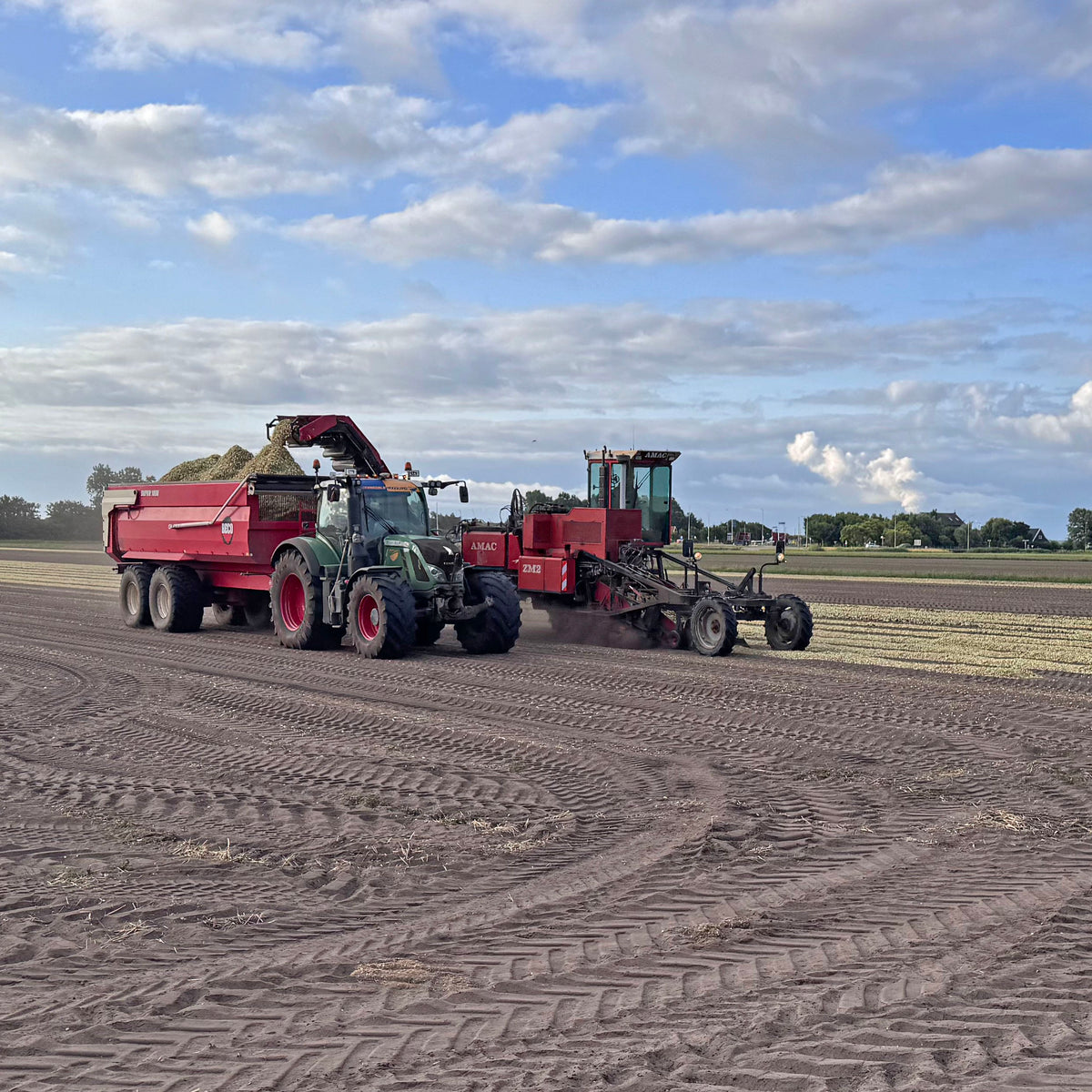
Would this end well? All the tulip growers were getting rather nervous. Suddenly, because of the heat, all the tulips turned brown at the same time. The last green leaves on the tulip plants were scorched by the fierce sun, and even tulips that would normally be lifted about three weeks after the earliest varieties had suddenly finished growing and needed to come out of the ground. And bulb growers know better than anyone: once a tulip has finished growing, it needs to be lifted. Leave it in the ground too long and it can become diseased. Of course, that creates a problem. The normal plan is for the tulip harvest to take just under four weeks. The machinery and the capacity in the sheds are all organised around that schedule. But when everything suddenly needs to happen within one week, things start to grind to a halt. And they did. Fortunately, Mother Nature was forgiving this year. After first playing the trick of making all the tulips — early and late — die back at almost exactly the same time, she then made sure that the soil became so dry, and stayed so dry, that the bulbs were actually quite happy sitting there for a little longer. A stroke of luck for the growers — and, of course, for us as well.

Our work mainly consists of packing and shipping flower bulbs, but another important part of what we do is checking their quality. At every packing machine, someone stands beside the conveyor belt to remove any bulbs that are not good enough. When the quality is excellent, you can almost do that job with your eyes closed. The bulbs race along the belt, the counting machine rattles away like mad, and you have one person at the belt while three others are sweating away trying to keep up behind the counting machine. If on the other hand, the quality is poor, it can suddenly be the other way around: three people at the belt and one person behind the counting machine who, between closing bags, still has enough spare time to pick his nose

Lunch break
But apart from the occasional exception, the quality this year is simply very good. The bulbs are not larger than usual — if anything, they are slightly smaller than we are accustomed to. That’s mainly due to the slightly premature withering of late-flowering tulips in particular.
Every now and then, a grower calls to tell us that he cannot supply quite the full quantity of tulip bulbs he sold us, but those are exceptions. So far, we are very pleased with the quality. We simply have some really excellent, beautiful bulbs in the shed. Around this time of year, the growers are more or less finished delivering the tulips and it is the daffodils’ turn. Just like the late tulips, the daffodils also had to endure plenty of very hot weather. But, as everybody knows, a daffodil is just that little bit tougher.

Daffodil mixture ‘Sunshine Boys’ — two reliable daffodils that will never let you down.
People sometimes say that daffodils grow best in wind and rain. And that is absolutely true. But remember that daffodils originally come from Spain, southern France and the Alps: mountainous areas where spring can bring snow, melting water and cold, harsh winds — conditions in which the daffodil feels perfectly at home. Two weeks later, the sun can suddenly be blazing away and everything becomes baking hot. And guess what? The daffodil loves that too.
Long story short… plant more daffodils. Just kidding — plant loads more.

Narcissus Chiquitita — a lovely little one
There is, of course, a grain of truth in all of this. The daffodil is simply the best and most beautiful flower bulb in the entire world. Not that you are a complete fool if you do not have any daffodils in your garden, but still.
There is, incidentally, another bulb that comes fairly close to the daffodil when it comes to sheer determination to survive: the Camassia. I have had them growing in my own orchard for decades. Honestly, they were planted about twenty years ago and every spring they are back showing off again. They even seed themselves around.

The good news is that this week I managed to buy three very beautiful new Camassias from Bram Duineveld’s Candle series: Violet Candle, Blue Candle and Sweet Candle. Three new Camassias your garden absolutely cannot live without. Well… a little exaggeration is allowed, isn’t it? Seriously though, the Candle Camassias represent a new generation of Camassia with sturdier plants, larger and longer-flowering blooms, and more beautiful colours.
Bram bought them from the breeder when he was still a little boy at school — I reckon he’s still there, actually — and his father allowed him to plant them at the nursery. When I popped round to the neighbours’ this week, I couldn’t even get out of the shed before I’d said yes to Bram – he was doing his absolute best to sell them to me. Well, that’s not entirely true, because Bram’d been kicked out of the shed by his dad with his Camassias. The shed has become too small, so they are extending it.
To be fair, Bram did not need to persuade me at all because I already wanted to introduce them to the Fluwel webshop. I think — in fact, I am almost certain — that Bram has struck gold with the Candle Camassias. Once people discover just how good and beautiful these Camassias are, they will be queuing up at his door.

These new Camassias are definitely worth trying.
For now, I am going back to work with my daffodils.
Kind regards,
Carlos van der Veek
P.S: Do you already follow us on Facebook and/or Instagram? My colleagues share the most beautiful photos, videos and updates there.