Amaryllis
Dear readers,
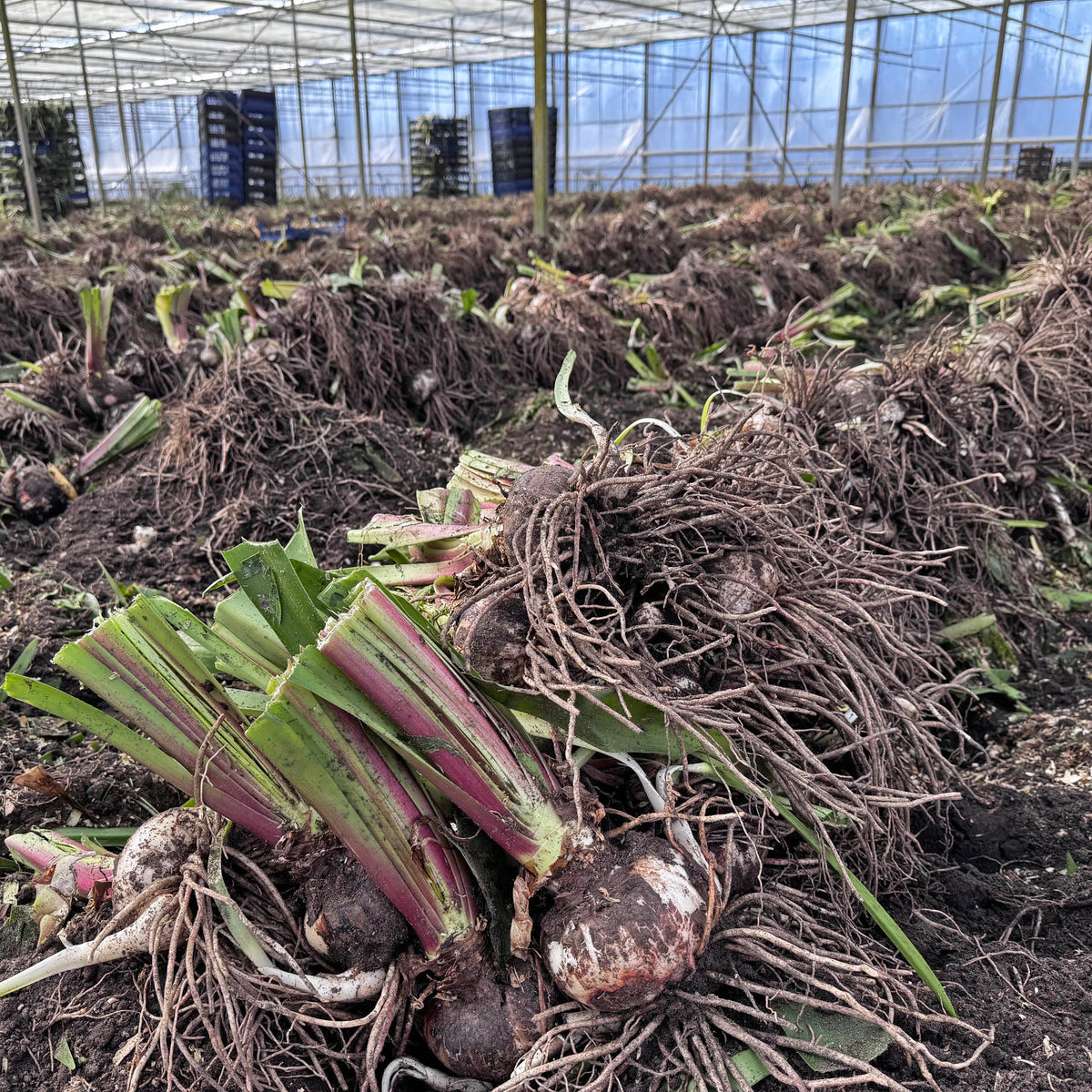
The moment is finally here. Our warehouse is full of freshly harvested
Amaryllises. The bulbs are looking beautiful, and they carry that trusted scent of Amaryllis bulbs that always accompanies them. We are looking forward to finally shipping them to you.
Asked Pien to draw something on these bulbs for the newsletter, and this is what I got… almost as if she has cats?
Our goal was to offer one hundred varieties, but at the moment of writing this, we are still just a few short of that number. You are reading this about three days after I’ve written it, so anything can have happened in that time, you never know. I just got a phone call from a befriended Amaryllis grower who told me that his Mandela-variety has abandoned him this year. Disappointing growth, bulbs that don’t meet the standard, another variety taken off this year’s list. If that keeps going on, we’ll never make it to 100, but we keep trying.
Amaryllis Candy Belle
If you are a true Amaryllis enthusiast, I do want you to know that I am serious about the harvest being slightly disappointing this year. If you have varieties you really, really want, I do urge you not to wait too long. Even for some of the varieties we do offer, the number we have in stock is smaller than usual, and I would not want you to miss out on anything you’ve been thinking about all year.
If you aren’t as familiar with Amaryllises, I will give you a short explanation on how to best grow them in your home
The best course of action is to plant an Amaryllis bulb in potting soil right after you’ve received them. Put them in a warm place in your home and they will start growing. The type of soil you use doesn’t make that much of a difference, regular potting soil is just fine, and I even use soil from my garden sometimes. When it comes to soil, an Amaryllis isn’t picky.

It is also possible to grow Amaryllises on water. In this picture, you see an Amaryllis bulb in an Amaryllis vase. We sell these vases in our web shop, but you can also put them in something you already own if it has the right size. If you use a vase without any curve in it like you see here, it could help to put small stones or marbles at the bottom. After that, you put the vase in a warm place in your home, same as the potted Amaryllises. They will start growing the same.
If you want to put your Amaryllis on water, make sure to remove as many dead or crumpled roots from the bottom of the bulb, and to only leave the sturdy live ones on. Then, make sure the roots touch the water, but the bulb itself remains dry. During the first week, it helps to refresh the water once or twice, as it becomes kind of cloudy otherwise. Once the water remains looking fresh, you can just add small bits to it to keep it at the right level: roots wet, bulb dry.
 Amaryllis Picasso
Another option is to receive your Amaryllis bulb and then decide to
gift it to a friend, family member, or neighbour. This way, you are almost guaranteed to receive photographs of the Amaryllis once it blooms without you having to do anything else for it. And as an added bonus, people will think of you as someone who gives such nice gifts every time they look at their Amaryllis.
The last option is receiving the Amaryllis and then forgetting you have it. This can happen when you don’t open the bag, or maybe not even the box. A very sad situation, because then you can’t enjoy the Amaryllis at all. And the Amaryllis itself won’t even be stopped by this, because even when you don’t do anything, the bulb will start growing a stem and a flower, even when left in its packaging. Not an ideal situation, but I am telling you because I want to emphasize just how hard it is to mess up when it comes to Amaryllises. They are sturdy bulbs, and very reliable. They always grow and flower.
 These two La Paz Amaryllis bulbs were found in their box in our warehouse… catastrophe.

The same pot one week later, the Amaryllises corrected themselves and have since also started flowering. Forgetting them didn’t take them down.
But as a piece of advice after all of this, an Amaryllis shows her full potential when planted in soil and placed in a warm spot in your home. That goes for every variety in our web shop, and I am sure there is something there for you. Our assortment has an incredible range of Amaryllises, and we are proud to be able to offer them to you.
Anything else to tell you this week? I came across this, who knows what we are looking at here?
 Not an owl, this is a flower bulb. A pretty one at that. I visited a grower in Dirkshorn this week and he showed me these flower bulbs he had cut in half. I thought it was funny, let’s take a closer look if you don’t recognise it yet:
This is a Fritillaria, Fritillaria persica Purple Dynamite to be precise. This is how you multiply those bulbs. Growers cut off the upper half of the bulb. These cutoffs are put in a warm, dry spot, and after about a week you see small points of growth on the cutting surface. These dots grow into small Fritillaria bulbs. One halved bulb can produce 10 to 40 babies. This one will be planted like this, and next summer, the grower hopes to harvest a bunch of baby bulbs in its place. Then, he needs another two years of planting, growing and harvesting the baby bulbs before they are big enough to be shipped and sold.

This is Purple Dynamite, a fantastic bulb. This flower is the tiny dots you saw in the previous picture, but three years later. This grower also told me we van buy them next year, when he has enough of them. I will definitely come back to them in the newsletter once they go on sale on the web site, because I am sure they are perfect for some of you.
Time to wrap it up again.
Kind regards,
Carlos van der Veek
PS: Do you already follow us on Facebook and/or Instagram? My colleagues share the most beautiful photos, videos and updates there.