

Exploring the Mudflats Behind Fluwel with the Red-necked Phalarope

Last week we still had to go all the way to Texel for it, but now we can do it right behind the Fluwel shed: walking on mudflats
Dear readers,
Dear readers,
Flower bulb growers sometimes choose to flood a field. This is done to get rid of weeds, fungi and small bulbs left behind in the soil. Quite a clever method really; there is plenty of water in the polders, so drown the whole lot. Especially on intensively cultivated sandy soils, this method is very popular. It is a good way to get rid of a lot of trouble without using chemicals. What is striking about the photo above is that there is not a bird to be seen. Well, there is a strange duck peering out, but apart from that… not a bird to be seen

Normally these fields are absolutely crowded with our feathered friends, but unfortunately the birds were not too pleased with my arrival. Neither was the birdwatcher who was happily standing there with his binoculars and telescope. I thought I’d have a quick chat as I walked over, but it went rather awkwardly, Once the ice was finally broken, it turned out that my arrival had scared off the Red-necked Phalarope. Well, how was I supposed to know? I had not even seen her being there. Fortunately, he could still enjoy a few feeding Ruffs in the neighbouring field, where there were still plenty of birds around. The Ruff, and this surprised me, apparently turns up quite often on flooded flower bulb fields. That amazed me because I thought the Ruff was quite a rarity. And that is true: as a breeding bird it is no longer very common, but as a migratory bird it still visits us regularly.

“Flower Love U, We Enjoy Life.” Yes, I had to write it down because this week I was asked twice what Fluwel actually stands for. Then I thought, “I really should mention that in the newsletter again,” and just now it popped back into my head. It is actually quite funny that with things like “the meaning of Fluwel” I assume people already know, when of course that is not necessarily true at all. I often have that when I am writing: I think something does not need explaining because I have already mentioned it before. What I forget is that I have been writing these Sunday newsletters for ten years now, and of course it is perfectly understandable that all our dear readers do not read or remember every little thing I scribble down. And besides, when I started writing my newsletter, I only had one reader: my mother.

This is what grows inside the heart of a Tulip during the summer months
So I’m going to reiterate what I’ve mentioned before: the bulb is by no means dormant during the summer months. Everyone always thinks that once a bulb plant dies back at the end of spring or the beginning of summer, it begins a well-earned period of rest. A sort of long summer holiday. Nothing could be further from the truth. As soon as the plant above the bulb has died and summer begins, the bulb starts thinking about next spring. And next spring, the bulb wants to be among the very first to announce that winter is finally coming to an end.

A Daffodil bulb as it looks in October. The yellow-orange colouring in the centre of the shoot is formed by the stamens.
To achieve this, the bulb has come up with the following plan: it already starts forming its flower and leaves. As soon as the temperature rises in summer, the bulb uses part of the starch stored inside it as an energy source to begin developing the plant that it will show us in spring. With incredible precision, cell by cell, the entire plant is built up inside the heart of the bulb, right down to the smallest detail. At first, when the bulb has only just come out of the ground, there is nothing to see yet. But wait until September and take a look inside your bulb, and you will immediately see that it has been working very hard during the previous months. And if you look very closely – for that you will need a microscope – the bulb will amaze you with the precision of its work. Everything is already there, down to the tiniest detail. Leaves, petals, pistil, stamens, even pollen grains and the first beginnings of the roots could be found if your microscope were powerful enough. And here we were thinking that the flower bulb has a period of rest in the summer.

Allium Globemaster also forms its hundreds of individual little flowers one by one during the summer months. The round circle in the shoot will become its flower.
Perhaps a useful tip if you dig up your flower bulbs after the foliage has died back so that you can plant them again in autumn: make sure they get plenty of fresh air while they are being stored. Here in our shed I cannot say it often enough: bulbs need fresh air. Even though we cannot see it, the bulb is still growing and developing during the summer, and good growth requires oxygen. Poor ventilation means less oxygen, while enough oxygen contributes to a better-quality bulb in your garden next spring.

The Hazepolder at the end of the road.
The real resting period of the bulb takes place during the winter months. Its roots have fully developed in autumn and during winter it actually has very little to do. The only thing happening inside the bulb during winter is that its starch is converted into sugars. This allows it to grow even more explosively in spring as soon as the temperature starts to rise. That is the real strength of a bulb: long before spring has even begun, it is already completely prepared. Once winter is over, all it has to do is fill itself with water and grow into that beautiful flower that we – and many insects waking from their winter sleep – eagerly look forward to every year.

Daffodil Sun Cup. Ah, what a shame, they are looking the other way. If you look at the back of your phone, you will see the front.
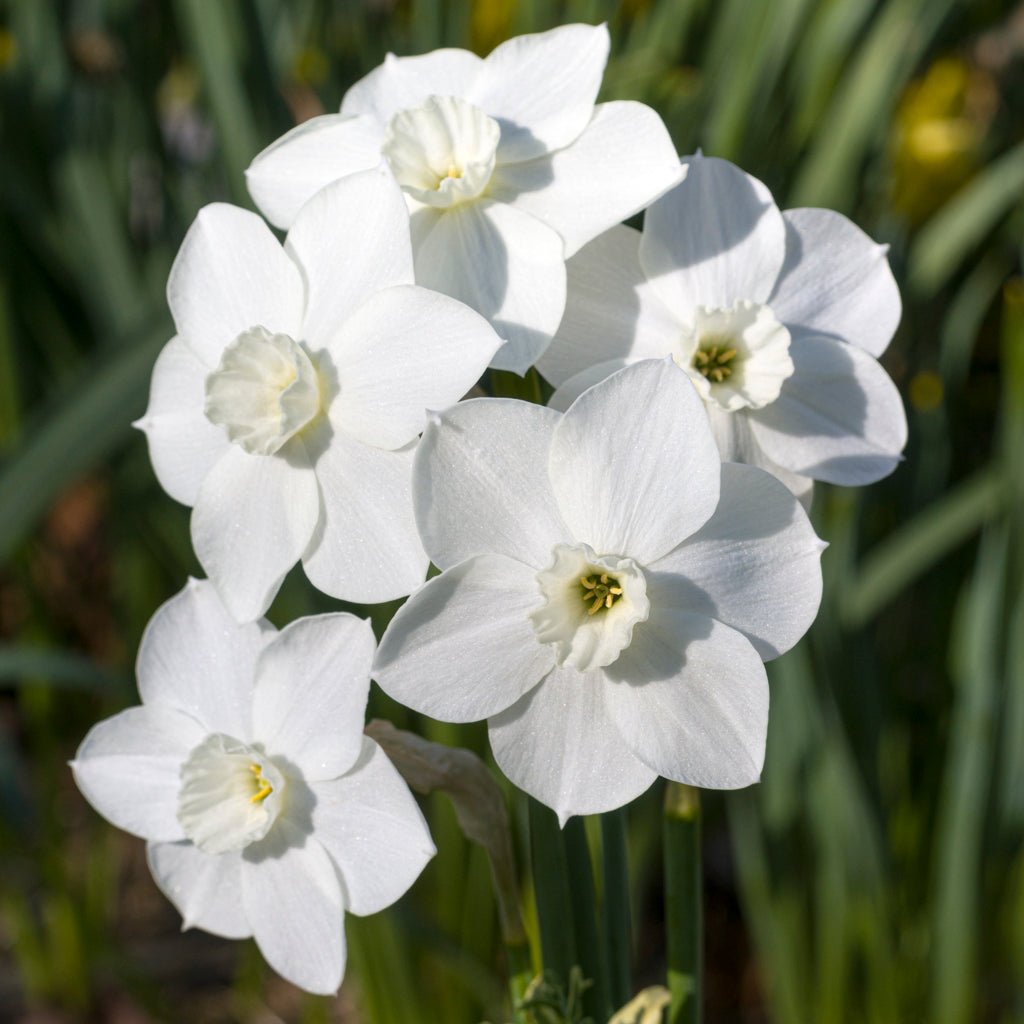
Enough of the serious stuff – now for a bit of business. The office just called to tell me that we have a few Daffodil Sun Cup left over. I was delighted to hear that, because Sun Cup is a real beauty. A real no-nonsense Daffodil: big, sturdy, strong, with flowers that simply make you happy. I had already told neighbour Ruud that if he had a few left over, I’d gladly take them.
For the Daffodil lovers, highly recommended.
Time to stop again. See you next week.

Just kidding, of course. Here’s Sun Cup. Isn’t she a beauty?
Kind regards,
Carlos van der Veek